Three True Stories.
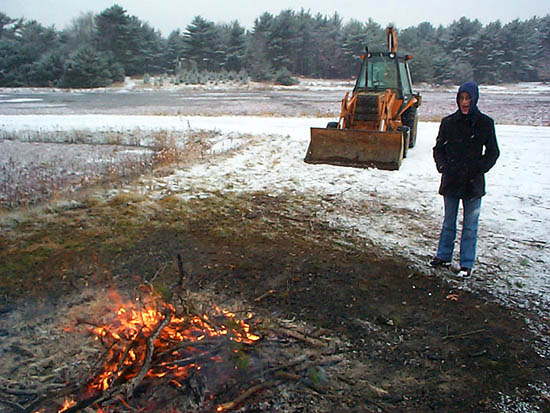 There's just something about a fire.
We'd thrown shredded tufts of wood, green and orange pine-needles, crumbling logs and scraggling branches into a pile between the fourth and sixth fairways. Under cold, overcast skies we stuffed newspaper here and there on the windward side of the pile, low to the ground, and Ted ignighted the paper with a green lighter. As we shuffled the brush around, the wind slowly worked the flames into the mound, deeper and redder. Thick white smoke eddied out from between the woodscraps, bubbling through the pile like gaseous gravy before rising out across the fairway.
Ted marched off to start clearing more underbrush, while I (in my $10 jeans, wool sweater, chamois shirt and trucker's hat) stayed behind to tend the fire with a rake and pitchfork. It was comfortable work. As the fire grew warmer, I thought about last Sunday's all-day Superbowl party at Dave's house, complete with our keg of Boston Ale, the video games we played, the batches of homemade chili that Adam and I had each brought, the Pats' incredible victory, the superbowls we smoked by the heat from the wood stove. A great end to a great weekend that seemed far away.
I stared down at the flames. The wind continued to blow the crackling cinders of pinesmoke across the two-hundred or so yards of greens and trees between where I stood and my family's two-story suburban saltbox house. The domestic associations were easy; fresh pine logs burn into the thick smoke of post Thanksgiving dinner naps in my living-room, of ritual stocking-hanging above the fireplace on Christmas Eve. It occurs to me that since I'm moving to Los Angeles, it will be the better part of a year before I next smell burning pine filling my house with the smell of New England winter.
There's just something about a fire. It was too hot now, for my sweater, so I threw it on the ground by a small fir tree. I love that feel of heat radiating at you. During the summer when I was twelve, a small forest-fire caught and spread throughout what is now the seventh fairway. I had run out to watch it burn, and I remember the feeling of the blaze's heat firing toward me through he already hot July air. I was thrilled and frightened, bolting down the path toward Erik's house with my mouth hanging open, like a sweating Black Lab, when out of nowhere a yellow-jaket suddenly appeared and flew between my lips. I spit and coughed and slobbered, but not before the bastard had stung me directly on the tongue. That pinch had hurt so bad, and my tongue quickly numbed and swelled. God. I ran home, screaming with smokey tears, "Mahm, the woodths aah on fiah, the woodths aah on fiah, an a bee sthung my thung!" I'll tell you that nothing dampens the glorious sight of firefighters and forest trucks containing and extinguishing a forest-fire in your backyard like the painful aching of your own bee-stung tongue.
Staring down at the now engulfed brush-pile, I laughed out loud at the memory of my own bad luck. I grabbed the rake and did my best to pull renagade sticks and branches in towards the center of the pile. I amused mysef, tossing the remaining bits of newspaper onto the blaze, watching them curl and blacken. I love the way fire consumes paper and ink. And just then, an image popped into my head that I hadn't accessed in ten years: after the final day of eigth grade, I wandered out into the woods armed with my school bag and a can of denatured alcohol. There used to be an old rusty barrel hiding somewhere on the land now occupied by the sixth fairway; on that sunny June afternoon I tore every page out of my English binder, stuffed them all into the barrel, doused the paper in alcohol, and burned every inch of my English notes.
I'm not exactly sure why I did that, but based on what I remember about my grades in that class, I can imgaine. The fire was really burning now, and I moved side to side with my rake to avoid the heat and smoke. The wind had blown the fire across the entire pile, and it now began to slowly consume the dry off-season grass on the far side, away from the wind. I made quick, awkward dashes through the slanting tower of smoke, trying to stamp out the short advancing flame frontier. I remembered how quickly the long dry grass used to catch fire whenever Erik and I would play with matches out in this area. We'd light matches at the ground until our hearts raced as the flames spread spastically, then we'd jump around to extinguish them, narrowly avoiding a complete loss of control. The thrill of irresponsibility. Once, just around dusk, we stooped down behind a bush, just across the way, and attempted to smoke cinnammon sticks. There was a great deal of coughing until dinnertime, as I recall. We must have been nine or ten, back then.
Midway through my final attempt to stamp out the flames, I heard the soft screech of hair on the left side of my head singeing. My eyelashes had taken a hit, too. The smell of burning hair is truly awful; I wondered if aversion to the foul odor might be wired directly into our genes.
A few scattered raindrops began to fall. Ted returned, and I showed him my singed hair. He showed me how he had just accidentally cut through his pants and boxers with a still-spinning chainsaw blade. His skin didn't suffer a scratch, thank God. We stood with our arms crossed, watching the hot embers cool, talking about the golf business, about my plans to drive out west and his time in the merchant marines, about terrorism and religion and fire and people who fear cults. I thought about those Saturday night campfires at Camp Squanto, the Boy Scout camp only a few miles into the state forest where I used to spend a week every summer with Josh, Andrew, Tucker, Matt, and the rest of Troop 46. Everyone in camp would gather around for an hour and a half, as two log-cabin style fires slowly burned down. Sometimes, after all the kids, leaders and counselors finished their skits and songs, Woody would appear. We all knew him well, the 70-year-old enthusiastic veteran forest-ranger who lived year-round at the camp. He could often be seen tooling around on his ATV, smiling and chatting to the boys. When Woody came to these closing campfires, it was to retire old American Flags: flags that were ripped, faded or worn through; flags that had hung spot-lit in one too many rainshowers; flags with too few stars, coming apart at the seams. With the help of a hook-ended metal pole and a few scouts, Woody would fold the flags into the campfires, always setting the blue field of stars into the flames first. "It's the field that makes the flag," he would tell all of us boys. "And once it is destroyed, the cloth is an American Flag no more." There was never any need to shush us scouts during those flag burning ceremonies; we'd instinctively pay calm attention, watching the colors turn to fire. "A flag buried into the earth will eventually touch the ground, no matter what the container," Woody would say at the end, before we all walked silently back to our individual troop sites. "And since the American Flag is never allowed to touch the ground, I believe that the only true and honorable way to retire a flag is to burn it, as we've done tonight."
There's just something about a fire, burning out as casually as this one. The rain picked up a little, so Ted and I hopped back into his Ford, deciding to let the fire fade to charcoal without supervision. I remembered one cold November campout, when Joshua and I poured water on our troop's small campfire just before lights out. With gloves, we rolled several hot rocks into his large canvas sailing bag, and set it just inside the door of our tent. We slept so well, that night, with such warm feet.